
We live in a world that rarely asks us to slow down. Our days are filled with things to do, places to be, people to see and an almost endless stream of information competing for our attention. Even the things we do to relax can become another task on the list.
So what happens when we step into a yoga class where, rather than being asked to do more, we’re
invited to do less?
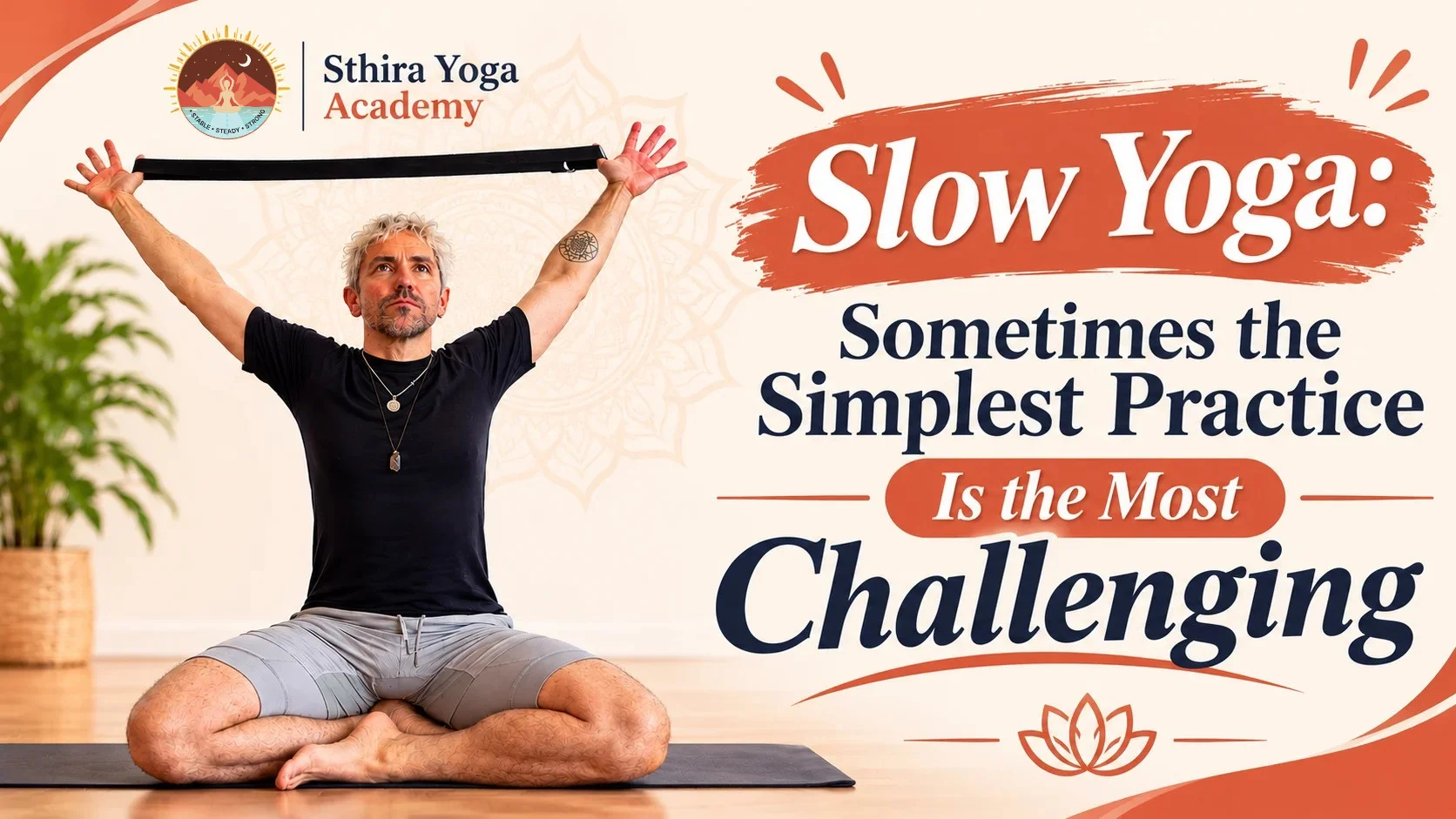
Welcome to Slow Yoga.
At Sthira Yoga Academy in Mittagong, I’ve deliberately chosen to keep the name simple. Slow Yoga. It’s
exactly what it sounds like, although the experience might surprise you.
What Is Slow Yoga?
Slow Yoga is a gentle, unhurried practice that allows time to settle into postures, explore comfortable variations and become more aware of the breath and body. Unlike more dynamic styles of yoga, where we move from one posture to another, Slow Yoga gives us the opportunity to remain in shapes for longer periods.
My classes are influenced by Yin Yoga, a practice that generally involves holding floor-based postures for several minutes, often with the support of props. But I don’t call the class Yin Yoga. Not because I don’t value the tradition or its approach, but because I want people to feel comfortable
walking through the door without needing to understand yoga terminology first. Sometimes the simplest name is the most welcoming.
Why I Call It Slow Yoga Rather Than Yin Yoga
Yoga has developed an extraordinary vocabulary of styles, traditions and approaches. Vinyasa, Hatha, Yin, Restorative, Kundalini. For someone familiar with yoga, these words can be helpful. For someone considering their first class, they can also be confusing.
I don’t want anyone wondering whether they need to understand a particular style before they’re welcome to participate. Slow Yoga tells you what you need to know. We’ll slow things down.
There will be time to breathe, time to move and time to settle. There is no expectation to perform a posture perfectly or keep up with anyone else. It’s yoga without unnecessary complication.
The Unexpected Challenge of Slowing Down
Here’s something that often surprises people. Slow Yoga isn’t necessarily easy.
In a world that rewards productivity, activity and constant doing, being invited to become still can feel surprisingly uncomfortable. When we stop moving, we may begin to notice things that ordinarily go unnoticed: restlessness, impatience, physical sensations or the simple urge to move on to whatever comes next.
Sometimes the challenge isn’t the posture itself. It’s allowing ourselves to remain there. This isn’t something we need to overcome or force ourselves through. It’s simply an opportunity to notice our relationship with stillness. And perhaps to become a little more comfortable with not always having something to do.
What Happens in a Slow Yoga Class?
A Slow Yoga class at Sthira is generally floor-based, with postures explored at an unhurried pace.
You might experience:
Gentle movement to prepare the body.
- Gentle movement to prepare the body.
- Seated and reclining postures held for several minutes.
- Time to notice the breath and physical sensations.
- The use of bolsters, blankets and blocks for comfort and support.
- Periods of quiet and stillness.
- A final relaxation to complete the practice.
There’s no need to achieve a particular shape. Different bodies require different approaches, and variations are always encouraged. Sometimes a bolster or blanket can completely change how a posture feels. Sometimes the most useful choice is to come out of a posture altogether. The practice is yours.
Is Slow Yoga the Same as Yin Yoga?
Slow Yoga at Sthira draws heavily from Yin Yoga, but the name allows me to teach in a way that is accessible and responsive to the people in the room. Yin Yoga typically involves longer-held, predominantly floor-based postures, with an emphasis on exploring sensation without unnecessary muscular effort.
Restorative Yoga, by comparison, generally uses more extensive support to encourage physical comfort and deep rest. Slow Yoga can include elements of both, alongside gentle movement, breath awareness and relaxation. Rather than becoming too concerned with the labels, I prefer to focus on the experience. How does the practice feel? What do you notice? What might change when you give yourself more time?
The Benefits of Practising Slowly
A slower yoga practice offers an opportunity to develop a different relationship with movement and rest.
Some people find it helps them:
Explore mobility and flexibility without rushing.
- Explore mobility and flexibility without rushing
- Become more aware of physical tension and habitual patterns.
- Develop patience and attentiveness.
- Create space for relaxation.
- Build familiarity with breathing and stillness.
- Balance a busy or physically demanding lifestyle.
It’s important to remember that deeper stretching isn’t necessarily better stretching. We’re not trying to force the body into greater ranges of movement. Instead, we’re exploring appropriate sensations with time, support and choice.
You Don’t Need to Be Flexible
One of the most common misconceptions about yoga is that you need to be flexible before you begin. You don’t. You also don’t need to be particularly fit, experienced or familiar with yoga terminology.
At Sthira, we use bolsters, blankets, blocks and other props to make postures more accessible. You are encouraged to adapt the practice to your body, rather than attempting to make your body fit a particular posture. There’s no requirement to perform any pose
A Little Less Doing, a Little More Being
Perhaps the most valuable part of Slow Yoga isn’t something we can easily measure. It’s the opportunity to spend an hour without needing to accomplish anything. No targets. No performance. No competition. Just time to move gently, breathe and become a little more familiar with ourselves.
That doesn’t mean every moment will feel peaceful or comfortable. Some days the mind will be busy. Some days the body will feel restless. That’s part of the practice too. We don’t need to manufacture stillness. We simply make room for it.
Experience Slow Yoga at Sthira Yoga Academy
Sthira Yoga Academy is a small, independent yoga studio in Mittagong, welcoming students from Bowral, Moss Vale and across the Southern Highlands.
Our Slow Yoga classes are 60 minutes and suitable for beginners as well as experienced students who enjoy a quieter, more contemplative practice.
Everything you need is available at the studio, including mats, bolsters, blankets and blocks. If you’ve been curious about yoga but unsure where to begin, Slow Yoga might be a lovely place to start. After all, the name says it all. Slow Yoga. Sometimes, that’s exactly what we need.
Leave a Comment
You must be logged in to post a comment.