
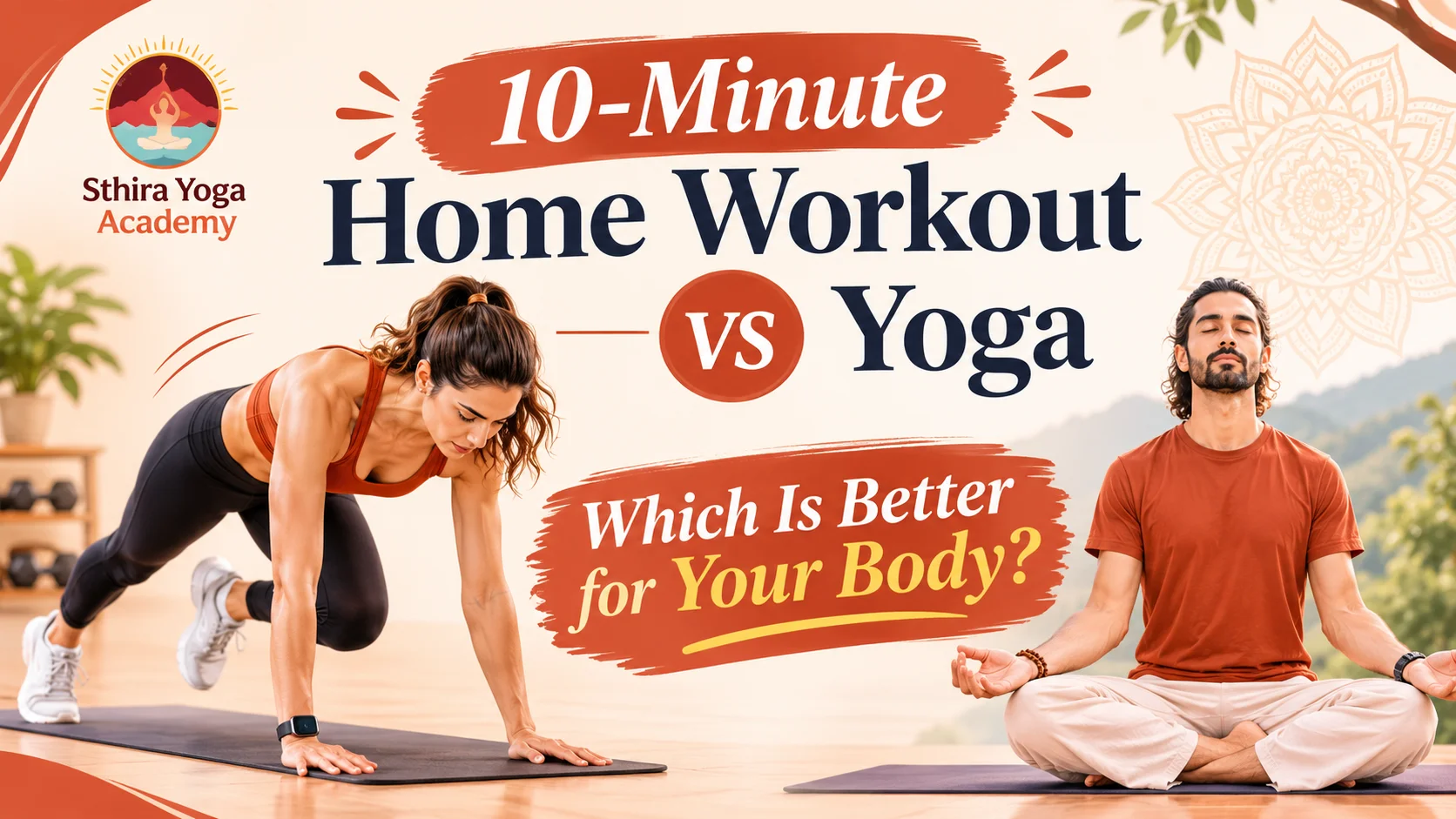
A practical look at what yoga does brilliantly, where strength training can help, and how to combine both when you only have ten minutes.
You Have 10 Minutes. What Should You Do?
Ten minutes is not a lot of time – but it is enough time to move your body, change your breathing and do something useful for your strength, mobility and general wellbeing.
The usual question is whether those ten minutes are better spent doing a workout or doing yoga. But that may be the wrong question. Yoga and conventional exercise overlap in many ways, while each also offers things the other may not provide as efficiently.
At Sthira Yoga Academy, I teach yoga – but I do not think asana has every answer for the modern body. A thoughtful movement practice can borrow from yoga, strength training, walking, resistance work and other forms of exercise without needing to choose a tribe
If you only have ten minutes today, the most useful question might simply be : what does my body need?
What Can a 10-Minute Home Workout Actually Do?
A short session will not replace every aspect of a longer exercise program, but ten focused minutes can still be worthwhile. It can interrupt a sedentary day, move joints through useful ranges, challenge muscles, raise your heart rate and establish a habit of regular movement.
For beginners in particular, a short home routine can also make exercise feel approachable. You do not need a gym, complicated equipment or an hour of spare time before movement becomes worthwhile.
10-Minute Yoga vs 10-Minute Workout: What’s the Difference?
| Yoga can emphasise | A home workout can emphasise |
| Mobility and range of movement | Progressive strength |
| Balance and coordination | External resistance |
| Body awareness and proprioception | Cardiovascular effort |
| Isometric strength | Repeated muscular loading |
| Breath and attention | Targeted muscle groups |
| Whole-body movement patterns | Pulling movements |
There is plenty of overlap. A strong yoga practice can be demanding, and a conventional workout can include mobility, balance and mindful breathing. The distinction is useful mainly because it shows why neither approach has to exclude the other.
Where Yoga Is Surprisingly Strong
Yoga is often described as stretching, but that undersells what many asana practices ask of the body. Chair Pose asks the legs to work. Plank loads the trunk and upper body. Warrior poses combine strength, mobility and balance. Bridge recruits the posterior chain. Moving between poses adds coordination and control.
Yoga also gives us something that is easy to lose in a fast workout: attention. We can notice the breath, the quality of movement, balance, tension and how the body is responding rather than simply chasing repetitions.
But Yoga Doesn’t Have Every Answer
I teach yoga, so perhaps I am supposed to tell you that yoga is all you need. I don't think that is true.
Asana can build considerable strength, but progressively increasing resistance is not always straightforward when the main resistance is your own body weight. Yoga also contains a great deal of pushing through the hands and arms – Plank, Chaturanga and Downward-Facing Dog are obvious examples – while true pulling movements are much harder to reproduce without equipment.
That is where a resistance band, dumbbells or conventional strength training can complement yoga beautifully. Cardiovascular exercise may also ask for a sustained level of intensity that a gentle yoga practice is not designed to provide.
Adding other forms of exercise does not diminish a yoga practice. It can make your overall approach to movement more complete.
Why Pulling Matters When Yoga Does So Much Pushing
Much of modern life already happens with our arms in front of us: computers, phones, driving and desks. Then we may arrive on the yoga mat and add more pushing movements.
A simple resistance band creates an easy opportunity to train the opposite action. Rows and other pulling exercises ask the muscles of the upper back and arms to work in ways that are difficult to reproduce in traditional asana.
You do not need a home gym. A basic resistance band can be a useful addition to a mat and a surprisingly effective way to broaden what a short home practice can offer.
Try This 10-Minute Yoga + Strength Practice at Home
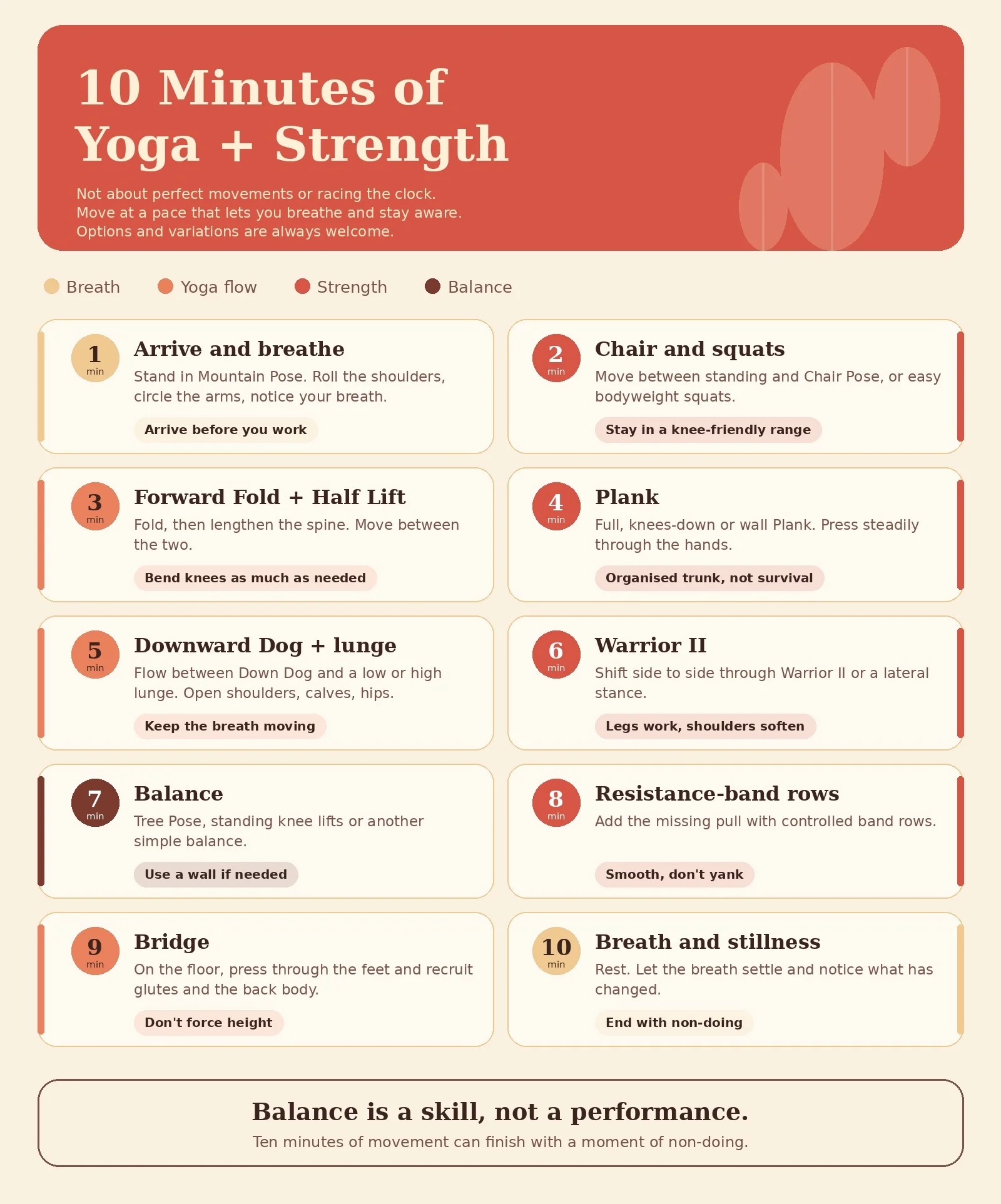
This is not about performing every movement perfectly or racing the clock. Move at a pace that allows you to breathe and stay aware of what you are doing. Options, choices and variations are always encouraged.
Minute 1 – Arrive and breathe
Stand in Mountain Pose. Let the shoulders move, circle the arms gently and notice your breathing. Give yourself a moment to arrive before asking the body to work.
Minute 2 – Chair and squats
Move between standing and Chair Pose, or use comfortable bodyweight squats. Work within a range that feels appropriate for your knees, hips and balance.
Minute 3 – Forward Fold and Half Lift
Move between a comfortable forward fold and a lengthened spine. Bend the knees as much as you need.
Minute 4 – Plank
Use a full Plank, knees-down Plank or a wall variation. Think about steady pressure through the hands and an organised trunk rather than simply surviving sixty seconds.
Minute 5 – Downward Dog and lunge
Move between Downward-Facing Dog and a low or high lunge. Explore the shoulders, calves and hips while keeping the breath moving.
Minute 6 – Warrior II
Move from side to side through a comfortable Warrior II or lateral stance. Let the legs work while keeping unnecessary tension out of the shoulders.
Minute 7 – Balance
Try Tree Pose, standing knee lifts or another simple balance. Use a wall if needed. Balance is a skill, not a performance.
Minute 8 – Resistance-band rows
Add the missing pull. Use a resistance band for controlled rows, keeping the movement smooth rather than yanking the band.
Minute 9 – Bridge
Come to the floor for Bridge Pose. Press through the feet and recruit the glutes and back of the body without forcing height.
Minute 10 – Breath and stillness
Come to rest. Let the breath settle and notice what has changed. Ten minutes of movement can finish with a moment of non-doing.
Beginner Modifications
Beginner does not have to mean ‘easy’; it means learning how to choose an appropriate version. Use a wall for balance or Plank, bend the knees in forward folds, shorten your stance in lunges and take rest whenever you need it. If a movement causes pain rather than ordinary muscular effort, change it or leave it out.
The aim is not to prove that you can complete all ten minutes exactly as written. The aim is to develop a sustainable relationship with movement.
Is Yoga Enough Exercise on Its Own?
That depends on the yoga you practise, what else you do in daily life and what you want your body to be capable of. A dynamic asana practice can contribute significantly to strength, mobility, balance and general fitness. A restorative or gentle practice has a different purpose.
Rather than asking yoga to provide everything, it can be more useful to see it as part of a broader movement life. Walking, resistance training, swimming, running, cycling or other activities can sit comfortably alongside yoga.
Is a 10-Minute Workout Actually Effective?
Ten minutes can absolutely be useful, particularly when the alternative is doing nothing because you do not have time for a longer session. What it cannot do is magically satisfy every movement, strength and cardiovascular need in one short routine.
Consistency matters. Ten minutes performed regularly can become a meaningful habit and can also be the doorway into longer sessions when time and energy allow.
How Often Should You Exercise for 10 Minutes?
A short routine can be used regularly, but the intensity and type of movement should vary with your body, experience and other activity. Some days might involve strength; another day might be mobility, walking or a quieter yoga practice. More is not automatically better.
Common Mistakes to Avoid
Rushing because it is only ten minutes. Short does not have to mean frantic. Good movement still deserves attention.
Confusing pain with productive effort. Muscles working is one thing; sharp, alarming or escalating pain is another.
Holding your breath. Breath gives useful feedback about how much effort you are using.
Always doing the same thing. Bodies benefit from variety: push, pull, squat, hinge, balance, walk, carry, rotate, rest and breathe.
Assuming stretching covers everything. Mobility matters, but so do strength, load and cardiovascular fitness.
Workout or Yoga: Which One Wins?
Your body wins.
You do not need to choose between being a ‘yoga person’ and someone who works out. Yoga offers breath, attention, proprioception, mobility, balance and a remarkable vocabulary of whole-body movement. Strength and conditioning make it easier to add progressive resistance, pulling, external load and targeted muscular work.
Do both if both serve you. And if today you only have ten minutes, ten minutes is considerably more useful than waiting for the mythical day when you have a spare hour.
Stable. Steady. Strong.
FAQs
Yes. A focused ten-minute session can support regular movement, strength, mobility and fitness, particularly when practised consistently. It does not need to replace longer exercise sessions.
Yes, provided the movements are adapted to the individual. Walls, smaller ranges of movement, slower transitions and rest are all valid options
Body weight is influenced by many factors, including overall activity, nutrition, sleep and health. A short workout can contribute to an active lifestyle, but it should not be treated as a stand-alone weight-loss solution.
The first minute or two can function as a gradual warm-up. Begin with simple movements and build
intensity rather than starting at maximum effort.
Most of the routine can be done with body weight alone. A resistance band is suggested because it
makes pulling movements easy to add at home, but it is optional.

Leave a Comment
You must be logged in to post a comment.