

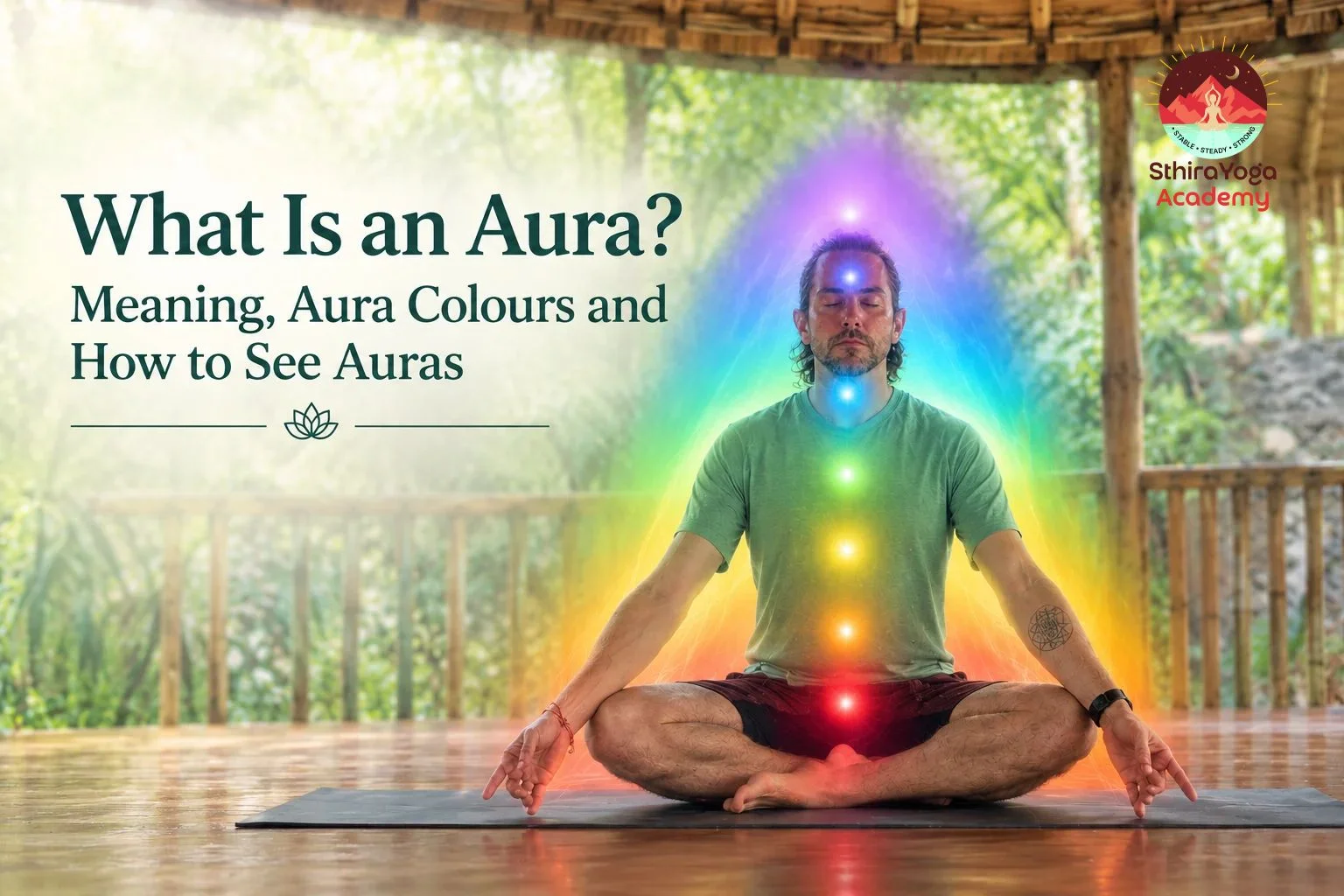
Introduction: Why Are People Curious About Auras
Have you ever walked into a room and immediately sensed something was wrong? Nobody has said anything. There may be nothing obviously different. Yet something in you has already registered the atmosphere.
The opposite happens too. Occasionally we meet someone and feel immediately comfortable in their presence. Conversation flows. There is an ease that is difficult to explain. Two people can pass one another without registering much at all, while another person’s presence can be unmistakable.
In yoga and other spiritual traditions, experiences such as these are sometimes described through the language of the auric field or aura.
When I teach Kriya and Kundalini-inspired practices, I sometimes describe the auric field more colloquially as our bullshit radar and force field. Not because I believe we should become suspicious of everybody around us, but because cultivating awareness can help us become more discerning about what we allow into our physical, mental and emotional space.
That feels particularly relevant in the 21st century. Our attention is constantly being requested. Phones, notifications, advertising, work, news, social media, other people’s opinions and expectations can rush into our lives from the moment we wake up. Thinking about an auric field can therefore be useful even if you don’t literally see coloured light surrounding people. It asks a valuable question: Where do I end, and everything else begin?
What Is an Aura?
An aura is generally described in spiritual traditions as a subtle field or energetic presence surrounding a person, animal or sometimes an object.
Some people report experiencing an aura visually as colour or light. Others describe it less literally: warmth, tingling, spaciousness, heaviness, attraction, discomfort or simply an intuitive impression of another person’s presence. The word can also be understood without any supernatural interpretation. We routinely talk about someone having an “aura of calm” or a place having a particular atmosphere. In that sense, an aura describes something we experience even when it is difficult to quantify.
Yoga gives us a vocabulary through which to explore these subtler aspects of experience, without requiring us to turn every spiritual concept into a scientific claim.
What Does Aura Mean Spiritually?
Spiritually, an aura is often understood as an extension or expression of our energetic state.
Different traditions explain this in different ways. In yogic philosophy we encounter concepts including prāṇa — vital energy or life force — and the subtle body, including nāḍīs, chakras and different dimensions of human experience. I find the aura particularly useful as a way of contemplating discernment and boundaries.
You can be compassionate without absorbing everybody else’s emotional state. You can listen without carrying every problem home. You can participate in the modern world without giving every demand access to your attention.
Rather than imagining the aura only as a glowing shield, we might think of it as a practice of
becoming clearer about what belongs to us, what doesn’t, what deserves our energy and what
can simply pass us by.
The Connection Between Auras and Chakras
Modern yoga and energy-healing traditions commonly associate the seven major chakras with a spectrum of colours:
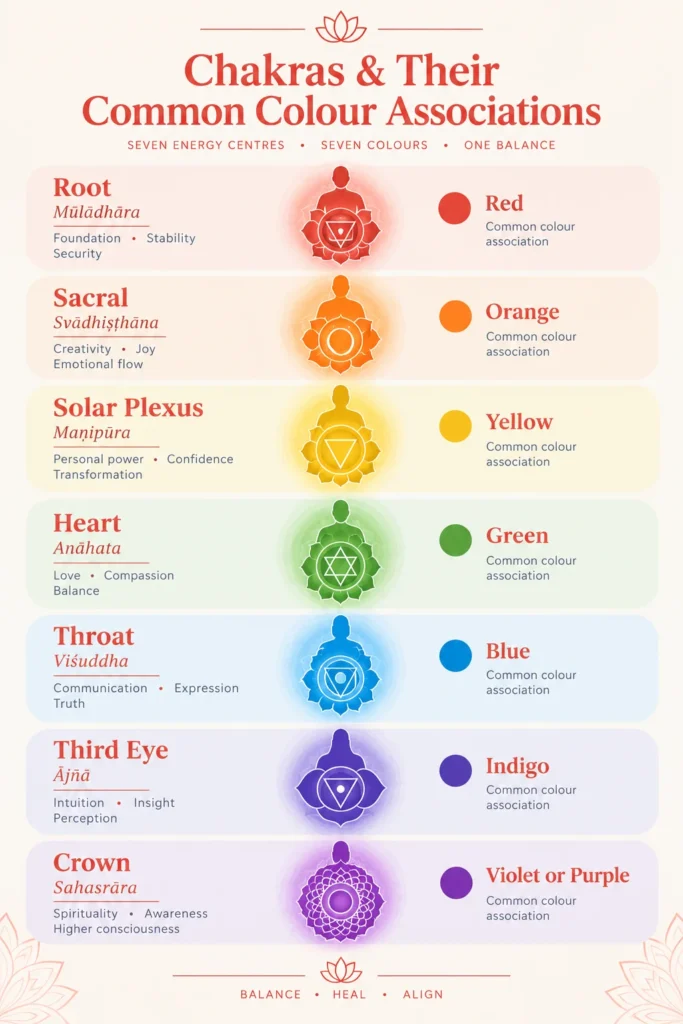
Chakra Common colour association
| Root | Mūlādhāra Red |
| Sacral | Svādhiṣṭhāna Orange |
| Solar Plexus | Maṇipūra Yellow |
| Heart | Anāhata Green |
| Throat | Viśuddha Blue |
| Third Eye | Ājñā Indigo |
| Crown | Sahasrāra Violet or purple |
These colour relationships should be understood as traditional or symbolic associations, rather than scientifically measured frequencies emitted by each chakra.
There is nevertheless a beautiful metaphor within the spectrum of visible light. Red light has a longer wavelength and lower photon energy than violet light. Moving through the visible spectrum takes us toward shorter wavelengths and eventually beyond visible violet into ultraviolet radiation.
This doesn’t scientifically prove a chakra hierarchy. But symbolically, the progression from red at the root to violet at the crown offers a compelling journey: from earth, survival and embodiment towards intuition, contemplation and states of awareness that become progressively more difficult to describe.
Beyond violet is something the human eye cannot normally see. For me, that is a far more interesting way of contemplating Sahasrāra: not as something we need to conquer or possess, but as a reminder that reality extends beyond the narrow band we are equipped to perceive.
How to See Auras
Some spiritual practices teach techniques intended to make an aura visually perceptible. Experiences vary considerably, and seeing colour isn’t necessary to explore the concept. If you want to experiment, approach it as an exercise in observation rather than a test you need to pass.
Prepare Your Environment
Choose somewhere quiet with soft, natural or diffuse lighting.
If observing another consenting person, a plain neutral background can make subtle visual effects easier to notice. You can also experiment by holding your own hand against a light-coloured wall.
Relax Your Mind and Body
Allow the breath to become comfortable and steady. Rather than concentrating intensely, soften. Notice the body, breath and surrounding space.
The harder we try to make something appear, the easier it becomes for expectation to influence what we think we are seeing.
Use a Soft Gaze
Instead of staring directly at the outline of your hand or another person, allow your gaze to rest slightly beyond it. Yoga practitioners may recognise this quality of attention. It is focused without becoming rigid.
You might notice brightness, colour, an outline or apparent movement around the edges of what you’re observing.
Notice Visual or Physical Sensations
Don’t limit the experiment to colour. What do you notice physically? Warmth? Tingling? Spaciousness? Calm? Tension? Nothing whatsoever? “Nothing” is also a perfectly acceptable observation.
The practice becomes more useful when we learn to notice what is actually happening rather than deciding beforehand what we are supposed to experience.
Practise Safely
Aura practices shouldn’t involve staring at the Sun, intense lights or anything that causes eye strain.
Visual disturbances can also have ordinary physiological or medical causes. New, persistent or significant changes in vision should not automatically be interpreted as an aura or spiritual experience.
What Do Aura Colours Mean
Popular aura-reading traditions associate colours with particular symbolic qualities. These interpretations aren’t universal, and an aura colour should not be treated as a fixed personality type, prediction or indicator of physical or mental health.
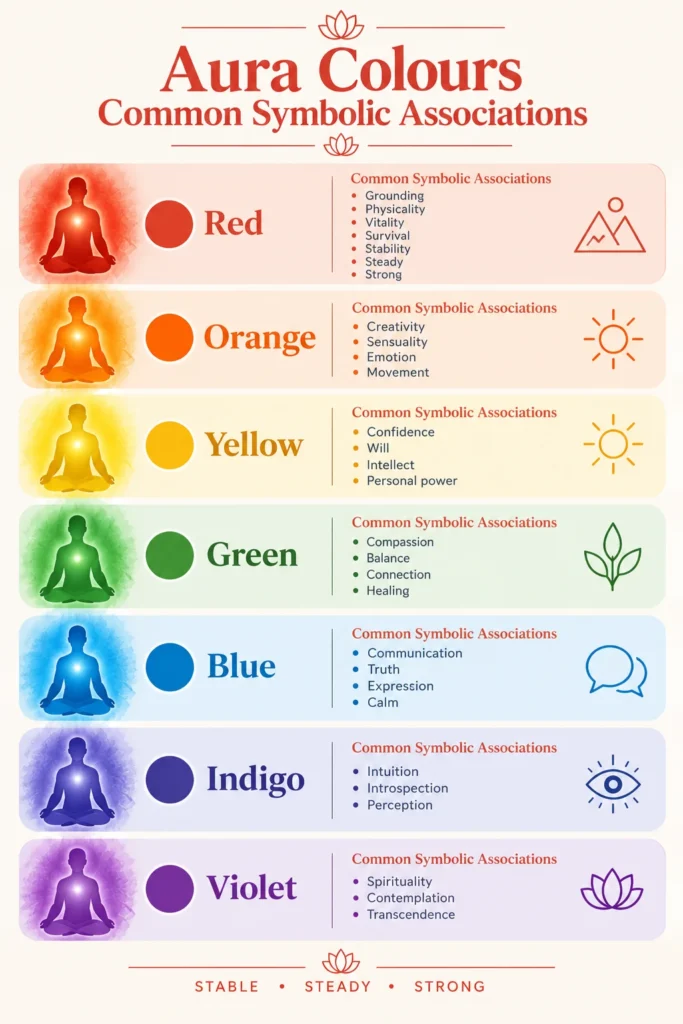
| Aura Colour | Common Symbolic Associations |
| Red | Grounding, physicality, vitality, survival, stability |
| Orange | Creativity, sensuality, emotion, movement |
| Yellow | Confidence, will, intellect, personal power |
| Green | Compassion, balance, connection, healing |
| Blue | Communication, truth, expression, calm |
| Indigo | Intuition, introspection, perception |
| Violet | Spirituality, contemplation, transcendence |
Colour itself has extraordinary psychological and cultural power. Red can mean blood, heat, danger, stopping, urgency and life. Blue can suggest sky, distance or calm. Green evokes vegetation and growth.
But these associations are partly cultural and contextual. They shouldn’t be mistaken for universal
laws of human energy.
Can Aura Colours Change?
Within aura-reading traditions, yes. Aura colours are often described as changing with mood, attention, circumstances and spiritual practice.
If we approach aura symbolically, this also makes intuitive sense. Human beings aren’t static. Our moods change, our attention changes, relationships affect us, and the quality of our presence changes from one day to another. An aura therefore makes much more sense to me as something dynamic than as a spiritual personality test.
Are Auras Real?
That depends partly upon what we mean by “real.” Spiritual traditions and individual practitioners have long described subtle energy, luminosity and sensations surrounding the body. For some people, these experiences have profound spiritual meaning.
Science requires a different standard of evidence. Visual effects around people or objects can arise from contrast, lighting, peripheral vision, retinal adaptation and afterimages. Expectation can also influence perception. Some unusual experiences of colour may be associated with forms of synaesthesia, in which stimulation in one sensory or cognitive pathway produces an additional experience in another.
Auras may be spiritually meaningful to some people, but their existence as visible coloured energy fields has not been scientifically established. Those two statements don’t necessarily have to fight one another. A contemplative practice can be meaningful without being a laboratory measurement.
Why Do Some People Say They Can See Auras?
There probably isn’t one explanation that applies to everybody. Some people understand their experience as spiritual sensitivity or heightened perception. Others may be noticing subtle visual phenomena created by light, contrast or afterimages.
Someone may also be extraordinarily perceptive of another person’s emotional state without consciously understanding how they know. Human beings constantly receive information from facial expression, posture, movement, tone of voice, distance, behaviour and environment. Much of that processing occurs without us deliberately analysing each cue. Sometimes we simply say:
“Something feels off.”
That’s my “bullshit radar.”
Whether we describe that as intuition, nervous-system perception, experience or an auric response may depend upon the framework through which we understand the world. Expectation matters too. If somebody tells us that we should see green around a person and we stare for long enough, our perception isn’t necessarily an objective measurement. Curiosity works best when accompanied by discernment.
Aura Reading, Aura Photography and Energy Healing
Aura reading attempts to interpret someone’s energetic state, sometimes through perceived colours or sensations.
Aura photography uses photographic equipment and software to produce colourful representations that are interpreted as a person’s aura. These images can be interesting or personally meaningful, but they should not be mistaken for scientific photographs proving the existence of a coloured biological energy field.
Similarly, practices described as energy healing can form part of someone’s spiritual or wellbeing practice, but they shouldn’t replace appropriate medical or psychological care. Yoga has survived for thousands of years partly because it invites practice. We don’t have to believe every claim made in yoga-adjacent wellness culture in order to remain open to mystery.
How to Explore Aura Practices Safely
For me, exploring the auric field is less about trying desperately to see colours and more about developing sensitivity.
Notice what happens when you enter a space.
Notice what happens around particular people.
Notice when your energy seems scattered and when it feels contained.
And importantly, learn the difference between intuition and assumption. Feeling uncomfortable around somebody doesn’t provide supernatural knowledge of their character or intentions.
An energetic practice should cultivate discernment, not judgement.
It should also never be used to diagnose illness. Claims that somebody’s aura reveals cancer, trauma, psychiatric illness or another medical condition should not replace qualified healthcare.
Polishing the Auric Field
In many of the pranayama, Kriya and Chi-inspired movements I teach, the arms and hands make large sweeping gestures through the space surrounding the body. I often describe these movements as polishing the lens of the auric field.
Why polishing?
Because life is gritty. Experiences accumulate. Other people’s moods affect us. Our own habits cloud perception. We get tired. We become distracted. Sometimes we lose the distinction between what we genuinely need and what the world has spent all day telling us we should want.
And anything that needs polishing requires friction. In yoga, that friction is tapas.
Tapas is commonly translated as heat, discipline or austerity, but I like to think of it as the transformative friction created by consistent practice.
- You show up.
- You breathe.
- You move.
- You repeat.
- You pay attention.
Again and again.
Perhaps those sweeping movements are polishing an invisible energetic field. Perhaps they are changing our proprioception, breathing, attention and nervous system. Perhaps the experience occupies territory that our current vocabulary doesn’t describe particularly well.
I don’t feel an urgent need to settle the argument. What matters in practice is what happens when the lens becomes a little clearer.
Simple Aura Reflection Practice
Stand comfortably with enough space to move your arms. Close your eyes if that feels appropriate and take several slow, comfortable breaths. Begin to notice the physical boundary of your body. Then notice the space immediately surrounding it.
Sweep your hands slowly outward and around yourself as though you were smoothing or polishing a large sphere surrounding the body. Let the movement become rhythmic.
Imagine brushing away everything you don’t need to carry: the conversation from this morning, somebody else’s bad mood, the notification you haven’t answered, tomorrow’s workload, yesterday’s frustration.
Not because these things aren’t real. Because you don’t have to carry all of them in this moment. Allow the movement to generate some heat. Let there be a little friction, a little tapas. Then become still. Notice the space around you again. You don’t need to see anything.
Simply ask:
Do I feel more present?
That question is enough.
Aura, Light and Wonder
There is another reason I remain fascinated by the language of auras.
Look upward.
The Sun itself has an atmosphere extending far beyond the bright surface we normally see. During a total solar eclipse, the Moon can obscure the brilliant solar disc and the Sun’s corona suddenly becomes visible.
From our position on Earth, the enormously different Sun and Moon can appear remarkably similar in size because of their respective sizes and distances from us.
Is that proof of some greater intelligence or cosmic design? Science can’t make that conclusion for us. But neither does science require us to stop experiencing wonder.
Yoga doesn’t always ask us to explain mystery away. Sometimes it asks us to become quiet enough to notice how extraordinary existence already is.
Perhaps that is another useful meaning of aura. Not necessarily a rainbow we need to see around somebody’s head. But the recognition that there may always be more surrounding what we can see than what our ordinary perception immediately reveals.
Frequently Asked Questions
An aura is commonly described in spiritual traditions as a subtle energetic field or presence surrounding a living being. People may describe experiencing it as colour, light, sensation or simply a quality of presence.
Spiritually, an aura is often associated with a person’s subtle energy, prāṇa, emotional state or consciousness. Interpretations vary considerably between traditions.
A common exercise is to hold your hand against a neutral background in soft lighting, relax your eyes and use a soft gaze around its edges. You may notice changes in brightness or colour. These can also result from normal visual processes such as contrast and afterimages.
Aura traditions symbolically associate colours with different qualities — for example, red with grounding, green with compassion, blue with communication and violet with spirituality. These associations aren’t universal or scientifically established personality categories.
The existence of visible coloured energy fields surrounding people has not been scientifically established. Experiences described as auras may involve spiritual interpretation, intuition, normal visual effects, expectation or, in some cases, phenomena such as synaesthesia.
Not everyone reports seeing auras, and being unable to see colours around people doesn’t indicate any spiritual deficiency. Awareness can be explored through breath, sensation, attention and reflection without seeing anything unusual.
Aura traditions commonly describe colours as changing according to emotional, energetic or spiritual states. Scientifically, there is no established coloured aura whose changes can currently be measured in this way.
No. Aura reading should never be used to diagnose a physical or mental health condition or as a substitute for professional medical care.
For me, the auric field ultimately comes back to something beautifully simple: awareness with boundaries.
The world will continue rushing towards us. People will bring their joy, anxiety, expectations and occasionally their bullshit. Life will continue throwing a little grit onto the lens.
Our practice isn’t necessarily about building a wall against any of it. It’s about learning how to polish the lens.
Stable. Steady. Strong.

Leave a Comment
You must be logged in to post a comment.